
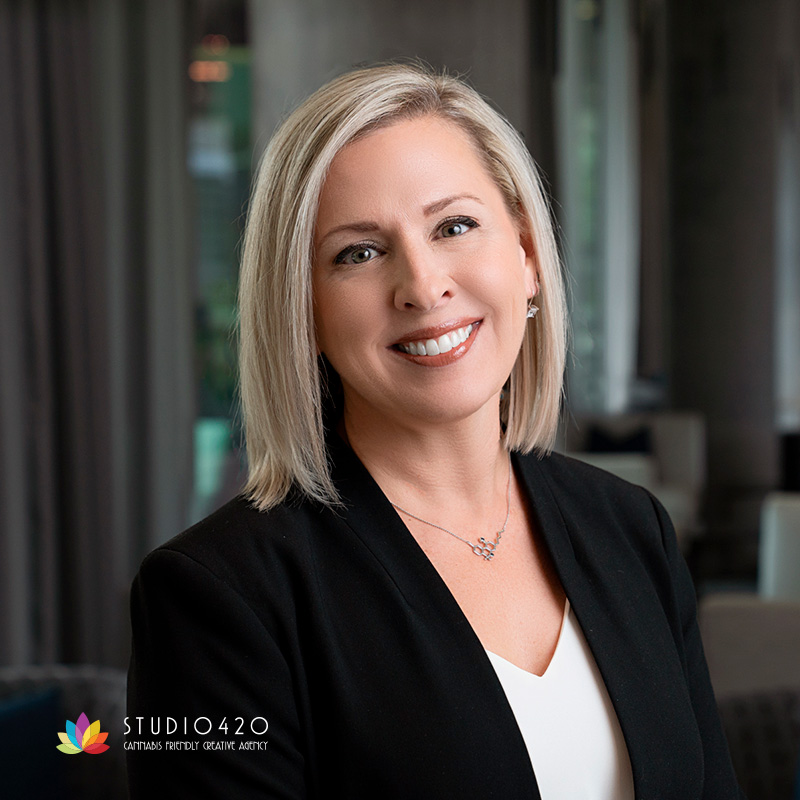
Amy has worked in marketing for over 20 years and is based in Denver, Colorado. She started her career in tourism and hospitality, which led her to work for a cannabis tour guide company.
In 2015, she worked at a marketing agency where she launched, built, and grew their cannabis division as the industry began to blossom.
Amy was also Chair of the National Cannabis Industry Association‘s marketing and advertising committee until August of 2021, when she landed the position of Marketing Director at TILT.
Let’s meet Amy to hear her approach to marketing the numerous brands and partnerships in the TILT portfolio. We also talk about their collaboration with the Shinnecock Indian Nation in New York and how it may set the standards for working with other Indian nations as part of their social equity initiatives.
Please give us an overview of TILT.
TILT Holdings is a multi-state cannabis operator with headquarters in Phoenix, and it’s where Jupiter, our core vaporizer hardware business, is located.
We are an MSO with vertically integrated operations in Pennsylvania, Ohio, Massachusetts, Pennsylvania, and Ohio that includes cultivation, manufacturing, distribution, and retail.
And we partner with CPG brands to manufacture and distribute their products to help them expand into other states.
We also announced a recent partnership with the Shinnecock Indian Nation and will expand into New York as that relationship matures in the next year.
TILT partners with CPG brands by investing in them and helping them scale in other states by using the resources and operations they have in these states. Do you also have partnerships with your dispensaries?
As you said, we partner with established brands looking to expand into the markets we operate in through a licensing agreement. TILT owns the dispensaries, and we sell wholesale out of our cultivation facility to other dispensaries in the states we serve.
It’s tricky. I see brands partnering with growers, but you’ve got much more to offer a brand looking to expand to other states as far as business infrastructure support.
It’s costly for brands to expand to other states in this legal environment, but as our partners, they have a way to ensure consistency and brand standards. It’s one of our growth strategies moving forward.
There are still so many states and brands you could bring into TILT. Are you also planning to manufacture your product line?
We do. In Pennsylvania, our product lines are under the Standard Farms brand. And in Massachusetts, our house brands are Chroma and Slate. We also do a lot of wholesale white labeling.
What is your working relationship with TILT’s partnership brands? How do you help them? How do you work together?
As a marketing and branding person, I know the importance of maintaining control of your brand and making sure people are talking about it the way you want them to talk about it and are selling it the way you want them to sell it.
When we work with brands, they maintain their marketing teams and hire their own brand ambassadors. We will Co-Op with them on social media, pop-ups, and things like that, but they get to maintain their brand’s authenticity, messaging, and control. We love doing events, partnerships, and promotions because those things are beneficial to their brand and our brand.
We have wholesale operations and sales teams in Ohio and Pennsylvania that service dispensaries in those markets. Our long-established relationships in the community will help get their products on the shelves in these dispensaries.
So, you specifically focus on TILT house brands: vaporizer hardware, dispensaries, cultivation facilities, CPG products, etc.
My job is to establish and maintain the TILT brand, brand awareness, thought leadership, and expertise. I work closely with our communications and social media team and arrange speaking events for our CEO.
My marketing approach is always to understand the goal, figure out the strategy, and then put the tactics in place to support it. What will work for our alternative care dispensaries in Massachusetts will not work for the Jupiter hardware b2b wholesale sales. Each business division is going to have different tactics.
How do you manage the different divisions?
Twenty years of working in an agency taught me to look at our marketing department as an agency and each of our business divisions as clients. And just as it would be at an agency, each client will have different budgets, goals, objectives, and KPIs that we need to hit. They’re all going to need different strategies and tactics that team members bring to life.
How are you building brand awareness for a national rollout when the time comes?
When we’re talking about marketing state by state, there are different regulations and rules and things you can or cannot say in the adult-use vs. the medical market. For example, in Pennsylvania, you can’t even use the word cannabis in promotional materials. It must say ‘medical marijuana.’ In Ohio, all social media posts must be approved by The Department of Health before you can post them!
From someone who hates getting a sales text message, I’ve had to accept that SMS text messaging has a massive ROI in the cannabis industry and is hugely successful when talking to consumers and promoting sales.
Programmatic advertising is growing day by day because of the restrictions on cannabis brands to advertise on Google AdWords, SEM, or SMS.
I like to think a little bit old school, like radio, because people are in their cars in most places. Here in Denver, hip-hop stations run ads for dispensaries between 9 am and 3 pm to guarantee that most of the audience is over 21 since everyone else is in school.
I’ve also heard great success from people doing direct mailers because you can target a zip code or demographic and track it with a coupon code. You just need to check with your postmaster to ensure you can do it.
The compliance piece is more challenging than I think anybody realizes until they get into it. At a national and state level, you have rules down to those counties opting out and cities and towns having different ordinances.
What do you see as the biggest obstacle for brands to generate sales?
The biggest obstacle is the lack of interstate commerce and the cost of setting up independent operations in multiple states.
There’s still a lot of distrust in the industry as it moves to destigmatize and legitimize cannabis. And people are intimidated to walk into a dispensary not knowing which products to buy because it’s an emerging industry and lacks brand recognition.
The dispensary layouts are not like typical retail stores where you browse and touch products. I’ve heard budtenders are given compensation from brands to push their products. I’m not sure how I feel about the pay-to-play scheme and budtenders.
If you look in liquor stores, you see that brands pay a premium to be on the end cap of an aisle. But, compensating budtenders to recommend products in the medical market doesn’t seem right.
Let’s talk about TILT’s recent partnership with the Shinnecock Indian Nation on Long Island, NY. Is this part of a social equity initiative?
Yes. Our partnership with the Shinnecock Indian Nation is designed with a social equity outcome at the heart of it. We are investing in upfront costs to build out the cultivation facility, dispensary, and wellness lounge and bring in our cannabis operational and management expertise.
We’re creating jobs, building businesses, and driving long-term economic impact for this tribe that has seen their lands eaten up and their way of life stolen from them. There are a lot of layers to the relationship at the end of the day, Shinnecock will maintain ownership of the business, and we’ll get repaid the loan.
Once we get this program up and running, we will take this relationship to other tribes to expand on TILT’s social equity initiatives.
Hopefully, the Indian nations will have a piece of the cannabis industry they deserve one day.
How often do you get to sit on the front end of an industry being reborn? It’s such a fun place to be and do something that has truly made a difference in many people’s lives. It makes me excited to get up and work in this industry every day.
#######
Studio 420 is a cannabis and psychedelics creative agency specializing in branding, UX/UI design, web development, ecommerce, and digital marketing solutions. We offer a variety of services to ELEVATE your online web presence.
Contact our Denver, Colorado office for a no-obligation, project cost analysis at 303-653-9855.
Panalokocasino sounds promising! Let’s see if it lives up to its name! Anyone ever hit a jackpot there? Hoping for a big win! Explore more chances: panalokocasino