Dispensary SEO Tips: How to Rank Higher on Google in 2026
What to fix first to rank a dispensary on Google in 2026: your Google Business Profile, location pages, a menu Google can read, speed, reviews and AI search.
Key takeaways
- Your Google Business Profile is the front door. Keep every field complete and current.
- A menu Google can read on your own domain beats a menu hidden inside someone else's frame.
- Speed is a ranking signal and a sales signal. Aim for Google's Core Web Vitals thresholds.
- Reviews and consistent listings build the prominence Google looks for.
- AI search tools quote pages that answer questions clearly and specifically.
Dispensary SEO comes down to the three things Google weighs in every local search: how relevant your store is to what someone typed, how close you are to them, and how well known you are. Most of that work happens outside your homepage, in your Google Business Profile, your menu, your reviews and the speed of your site. Here is what to fix first, in order.
Why dispensary SEO works differently
Google and Meta restrict cannabis advertising, so for most dispensaries organic search and the map are the main ways new customers find them. That raises the stakes on every detail a search engine can read: your listings, your pages, your menu and the reputation you build in reviews.
There is one more difference. Most dispensary websites open behind an age gate. Built as a light layer over content that is already on the page, it causes no trouble. Built as a separate screen that hides the whole site, it can keep search engines from reading anything at all.
1. Complete and maintain your Google Business Profile
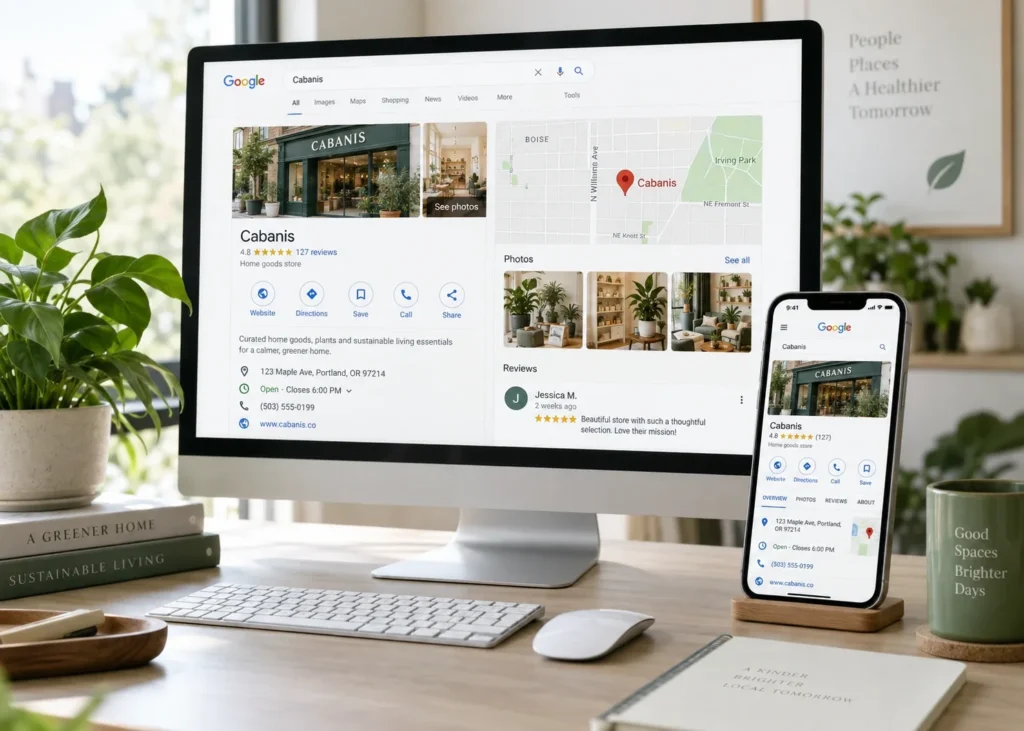
For a local store, the profile often matters more than the website. It is what people see on the map, before they ever reach your homepage.
- Choose the primary category that describes your store most precisely, and keep secondary categories relevant.
- Keep hours, holiday hours, phone number and address exactly right, and update them the day they change.
- Link each profile to the page for that location, not to your homepage.
- Add real photos of the storefront, the interior and your team, and refresh them through the year.
- Publish updates for events and news, within Google’s content policies.
- Reply to every review, the kind ones and the critical ones.
Our digital marketing work keeps profiles like these current every month, for single stores and for operators with many locations.
2. Give every location its own page
If you run more than one store, each one deserves a page of its own: the address, the hours, the phone number, what makes that store different, the neighborhoods it serves and a link to its menu. One page for all your locations forces Google to guess which store to show, and it usually guesses wrong.
Use the same name, address and phone number on the page, on the profile and on every directory. Small differences, such as “Suite” on one listing and “Apt” on another, weaken the signal.
3. Make your menu readable by Google
Many dispensaries show their products through a menu provider’s embed. It works for shoppers, but the products often live inside a frame that belongs to the provider’s domain, so your own site gets little or no credit for them.
Ask your provider whether it can render product and category pages on your own domain, in your site’s code rather than inside a frame. Then give each category a real page with its own title and a few lines of useful text: flower, pre-rolls, vapes, edibles, concentrates and topicals. Those pages are what people search for.
A well built dispensary website is designed around this from the start, with the menu, the age gate and the location pages working together.
4. Pass Core Web Vitals
Google measures how fast your pages load and how steady they feel. Its “good” thresholds are clear:
- Largest Contentful Paint, the time until the main content appears: 2.5 seconds or less.
- Interaction to Next Paint, how quickly the page responds to a tap or click: 200 milliseconds or less.
- Cumulative Layout Shift, how much the page jumps while it loads: 0.1 or less.
The usual culprits on dispensary sites are heavy images, sliders, pop-ups stacked on top of the age gate and too many third-party scripts. Compress images, serve modern formats such as WebP, cache your pages and remove every script that does not earn its place. You can check any page for free with Google’s PageSpeed Insights.
5. Build reviews and consistent listings
Prominence is how well known your store is, online and off. Reviews are a large part of it: how many you have, how recent they are and how you answer them. Ask happy customers at the counter and in your order emails, and never offer anything in exchange for a review.
Beyond Google, keep your listings on Apple Maps, Bing, Weedmaps and Leafly complete and identical. Every consistent listing is one more confirmation that your store is real and where you say it is.
6. Publish content that answers real questions
Your customers search before they visit. Answer what they ask: what to bring for a first visit, which payment methods you accept, how pickup or delivery works, how to read a lab result, what the difference is between product categories. Keep it educational and compliant, and avoid health claims.
Link those answers to the pages that matter, such as your location pages, your menu categories and your contact page. Internal links show Google which pages are most important.
7. Add structured data
Structured data is a short block of code that tells search engines what a page is about. For a dispensary, local business markup with your name, address, phone number, hours and location is the essential piece. It helps search engines and AI tools understand your store without guessing.
8. Show up in AI search
More people now ask ChatGPT, Perplexity or Google’s AI Overviews where to shop. These tools draw on pages they can crawl and quote. Give them clear answers near the top of each page, specific facts such as your hours and the areas you serve, and the same information everywhere your store is listed. Check that your robots.txt file does not block the crawlers you want to be cited by.
We cover this in depth, together with local rankings and menus, on our cannabis SEO page.
A dispensary SEO checklist
| Area | What to check | Why it matters |
|---|---|---|
| Google Business Profile | Category, hours, photos, updates, review replies | It is what shoppers see first on the map |
| Location pages | One page per store, linked from its profile | Google shows the right store for each search |
| Menu | Product and category pages on your own domain | Your site gets credit for what you sell |
| Age gate | A light layer over content already on the page | Search engines can still read the site |
| Speed | LCP, INP and CLS within Google’s thresholds | Better rankings and fewer abandoned visits |
| Listings | Same name, address and phone everywhere | Consistency builds trust with search engines |
| Reviews | A steady flow of recent reviews, all answered | Reviews drive prominence and clicks |
| Content | Answers to the questions customers ask | More searches lead to your pages |
| Structured data | Local business markup on every location page | Search engines and AI tools understand your store |
| AI search | Clear answers, specific facts, open to crawlers | Your store can be cited when people ask |
Where to start
If you only have an hour this week, spend it on your Google Business Profile. If you have a month, fix your menu and your speed. And if you would like a second pair of eyes, Studio 420 reviews dispensary websites and profiles from Denver, Colorado. Book a free call and we will show you what to fix first.
Want more ideas that work without paid ads? Read our dispensary marketing ideas, and if you are thinking of hiring help, our guide on how to choose a cannabis marketing agency.
Frequently asked questions
-
Fixes to your profile and your site can show up within weeks. Stronger rankings in a competitive market take longer, and depend on your reviews, your content and the strength of the stores around you.
-
Google's advertising policies restrict cannabis ads in the United States, so most dispensaries rely on organic search, the map, email marketing and social content instead.
-
Not when it is built as an overlay on top of content that is already in the page. A gate that hides the whole site behind a separate screen can keep search engines from reading it.
-
Yes. A page per store, linked from that store's Google Business Profile, helps Google show the right location to each shopper.
-
You need pages that answer your customers' questions. A blog is one way to publish them; guides, FAQs and menu category pages work too.