Cannabis Advertising Laws by State
California requires 71.6% of an ad's audience to be 21 or older, and Massachusetts 85%. The cannabis advertising laws by state, what Google and Meta allow in 2026, and where dispensaries can still advertise.

Key takeaways
- There is no single cannabis advertising law. Each state sets its own rules, and they change often.
- Most adult-use states use an audience test: an ad can only run where most of the audience is 21 or older, backed by real audience data.
- Every state bans ads that appeal to people under 21, and health claims put any cannabis brand at risk.
- Google and Meta do not accept ads for THC products. Only certified topical CBD has a narrow path.
- Your own channels carry the most weight: Google Business Profile, your website, your email list and your store.
Cannabis advertising laws are written by each state, not by the federal government, and most of them come down to one test: who is going to see the ad. In California an ad can only run where at least 71.6% of the audience is 21 or older. In Massachusetts the bar is 85%, and New York ties it to the share of state residents who are 21 or older, about 76% today. On top of the state rules sit the platforms, and Google and Meta still refuse ads for THC products in 2026. Here is what each rule means for a dispensary, where you can still advertise, and how to check an ad before it runs.
Why cannabis advertising laws differ by state
Cannabis is still illegal under federal law, so there is no national rulebook for cannabis ads the way there is for alcohol or tobacco. Each state that legalized cannabis wrote its own cannabis advertising regulations, usually in the same law or regulation that licenses dispensaries, and its cannabis regulator enforces them.
That has two consequences for a dispensary. The first is that a campaign that is fine in one state can break the rules in the next one, so a brand selling in several states needs a version of each ad for each market. The second is that the rules move. Regulators update them every year or two, and a guide that was right last year can be wrong today. Treat this article as a map, and check your state regulator’s current rules before you spend money.
The third layer is private. Ad platforms, broadcasters and billboard companies set their own policies, and many are stricter than the law. An ad can be perfectly legal in your state and still be rejected by the platform you wanted to run it on.
The audience rule: the number that decides where you can advertise
Most adult-use states do not ban cannabis advertising outright. They limit it to places where the audience is mostly adults. The rule is usually written as a percentage of the audience that must be 21 or older, and the advertiser has to prove it with reliable, current audience composition data from the publisher, the station or a measurement company.
Here is how the test reads in five of the largest markets:
| State | Audience rule | Other rules worth knowing |
|---|---|---|
| California | At least 71.6% of the audience must reasonably be expected to be 21 or older. | Every ad must show the license number of the business behind it. |
| Colorado | No more than 30% of the audience may reasonably be expected to be under 21, for TV, radio, print, internet and sponsored events. | No content that targets people under 21, including cartoon characters. |
| Massachusetts | At least 85% of the audience must reasonably be expected to be 21 or older. | The same bar applies to sponsored events, and the audience data has to be kept on file. |
| New York | The share of the audience that is 21 or older must at least match the share of New Yorkers who are 21 or older, based on the latest Census data (about 76%). | Billboards have their own limits on number, content and distance from places children gather. Check the Office of Cannabis Management’s current rules before you book one. |
| Illinois | No audience percentage in the law. | No cannabis ads within 1,000 feet of schools, playgrounds, recreation centers, child care centers, public parks, public libraries or arcades open to people under 21. |
Sources: California Business and Professions Code 26151, Colorado’s Marijuana Enforcement Division rules (1 CCR 212-3), Massachusetts 935 CMR 500, the New York Office of Cannabis Management and the Illinois Cannabis Regulation and Tax Act.
Other states, from Michigan to Nevada and Oregon, use their own version of the audience test or limits by location. The pattern is the same everywhere: the bigger the share of adults you can prove, the more places you can advertise.

How to prove the audience rule
The burden is on the advertiser, not on the publisher. Before you book, ask the seller for audience composition data that shows the age split of the people who will see the ad, and keep a copy with the invoice. A media kit with a vague “mostly adults” line is not enough. Age-verified audiences on cannabis marketplaces and data from measurement firms are the kind of proof regulators expect.
Keep the file even after the campaign ends. Massachusetts, for example, asks sponsors to keep their audience data for at least a year. If a regulator ever asks why an ad ran in a magazine or on a station, the answer should take one email, not a week of searching.
What every cannabis ad must avoid
The audience test decides where an ad can run. Content rules decide what it can say. Wording differs by state, but the core is shared almost everywhere:
- Nothing that appeals to people under 21. No cartoons, mascots, toys, candy imagery or young-looking models. Colorado names cartoon characters in its rules, and California prohibits products and ads that are attractive to children.
- No health claims. Do not promise that a product treats, cures or prevents anything. Health claims are the fastest way to a regulator’s letter, and federal agencies treat them seriously for CBD and hemp products too.
- Nothing false or misleading. Potency, prices, lab results and deals have to match what the store actually sells.
- The identifying details your state requires. California asks for the license number on every ad. Many states also require warnings or an age statement such as 21+.
- Care with giveaways and discounts. Some states limit or ban giving cannabis away for free. Check before you announce a contest or a free product.
When in doubt, cut the line. A plain ad that runs for a month does more for a dispensary than a clever one that gets pulled in a day.
What Google and Meta allow in 2026
Most dispensary owners first try the two biggest ad platforms. Both still say no to THC, but each has opened a narrow door for CBD.
Google Ads
Google does not accept ads that promote cannabis with THC. Since January 2023, its policy on unapproved substances lets two kinds of CBD products advertise: FDA-approved products that contain CBD, and topical, hemp-derived CBD products with 0.3% THC or less, certified by LegitScript. Those ads can only run in California, Colorado and Puerto Rico, and never to people under 18. Ingestible CBD, such as gummies, oils and drinks, is still out.
For a dispensary, that means Google Ads is closed for the store itself. Google’s organic results and Google Maps are not. A complete, active Google Business Profile is free, it is the first thing people see when they search for a dispensary, and it follows Google’s local listing guidelines instead of the ad policy. Our dispensary SEO tips cover how to set it up.
Facebook and Instagram
Meta does not accept ads for THC products. It does allow limited CBD and hemp ads: topical CBD certified by LegitScript, with written permission from Meta, never aimed at people under 18 and never with medical claims. Hemp products without CBD or THC, like hemp seed or fiber, can advertise in the United States, and education or advocacy ads are allowed as long as they do not sell a prohibited product.
Organic posts are a different matter. A dispensary can keep an Instagram or Facebook account, but posts that offer cannabis for sale, with prices, “DM to order” or delivery offers, put the account at risk. The accounts that last post about the store, the team, events and education, and send people to the website for the menu.
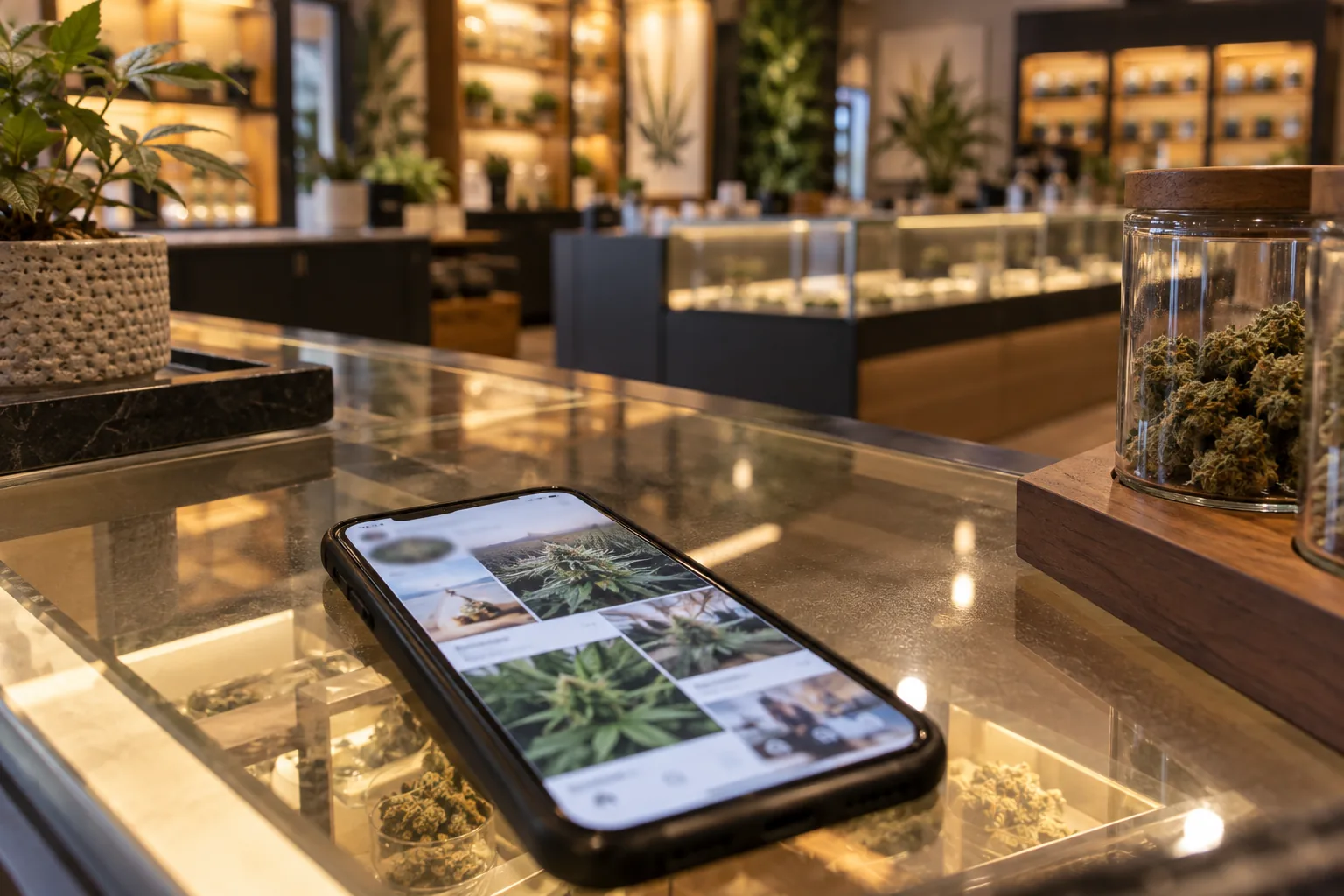
Where dispensaries can still advertise
Strict rules do not mean no dispensary advertising. They mean choosing channels where the audience is mostly adults and where you control the message.
- Cannabis marketplaces and menus. Shoppers already compare stores on cannabis marketplaces and menu platforms, and many of them check age before showing anything. Featured listings and deals there reach adults who are ready to buy.
- Cannabis-friendly ad networks. Some programmatic networks specialize in cannabis and sell audiences with age data you can keep on file for the audience rule.
- Out of home, where your state allows it. Billboards, transit and venue ads are possible in several states with distance limits from schools and parks.
- Sponsorships with adult audiences. Concerts, festivals and events for adults can carry your name if you can prove the audience meets your state’s test.
- Your own channels. Your website, Google Business Profile, email newsletter and in-store experience have no ad review and no audience test beyond keeping them 21+. They also cost the least over time.
The last point matters most. Paid placements stop working the day you stop paying. A website that ranks, a Google profile with reviews and a list of customers who opened your last email keep working, and they are the channels no platform can take away.
Build the channels you own
Because paid ads are so limited, the dispensaries that grow fastest invest in three owned channels.
Search
When someone searches for a dispensary nearby, Google shows the map and the local results before anything else. Location pages, a menu Google can read, fast pages and fresh reviews decide who shows up. This is where cannabis SEO pays for itself: it reaches people at the moment they are choosing where to buy, with no ad policy in the way.
An email list of adults who asked to hear from you is the most reliable channel a dispensary has. Use it for new arrivals, events, hours on holidays and education. Keep it 21+, make it easy to unsubscribe and never buy a list. Some email platforms do not accept cannabis businesses, so check the provider’s acceptable use policy before you build on it.
The store and the website
Signage inside the store, staff picks, the receipt, the bag and the website all count as marketing in many states, and the same content rules apply. The upside is that you control every word. Make the website the place your social posts, emails and Google profile all point to, with the menu, the hours and the address a tap away.
A checklist before an ad goes live
- Is the ad allowed in this state, on this channel, at this location?
- Do you have audience data that meets your state’s test, and is it saved with the invoice?
- Does the ad include everything your state requires, such as a license number or an age statement?
- Is there anything a person under 21 would find appealing, including colors, characters or candy imagery?
- Is there any health or medical claim, even a soft one?
- Do the prices, potency and deals match what the store sells today?
- If the ad runs on a platform, does it follow that platform’s policy as well as the law?
- If it is a giveaway or a discount, does your state allow it?
- Has someone who knows your state’s rules read it?
- Where does the ad send people, and is that page ready and compliant too?
This guide is general information, not legal advice. Rules change often, so confirm the current version with your state regulator or a cannabis attorney before a campaign goes live.
Where to start
Start with the cannabis advertising laws of your state, then put your budget where you control the message: your Google Business Profile, your website and your email list. Add paid placements only where you can prove the audience.
If you want help, our team plans dispensary marketing that stays within each state’s rules, and builds the local SEO that brings shoppers to your door without an ad policy in the way. Talk to us, or join our newsletter below for the next guide.
Want more ideas that work without paid ads? Read our dispensary marketing ideas, and if you are thinking of hiring help, our guide on how to choose a cannabis marketing agency.
Frequently asked questions
-
Yes, in states that legalized cannabis, within each state's rules. There is no federal law that allows it, so every state sets its own limits on where ads can run and what they can say.
-
It is California's audience test. A cannabis ad can only run where at least 71.6% of the audience is reasonably expected to be 21 or older, backed by reliable audience data. Other states use different numbers, such as 85% in Massachusetts, while New York matches the share of state residents who are 21 or older.
-
Not with Google Ads. Google does not accept ads for THC products. Only FDA-approved CBD and certified topical hemp CBD can advertise, and only in California, Colorado and Puerto Rico. Dispensaries can still appear in Google's organic results and on Google Maps through their Google Business Profile and their website.
-
Not with paid ads for THC products. Meta allows limited ads for certified topical CBD and hemp without CBD or THC. A dispensary can keep an organic account, but posts that offer cannabis for sale put the account at risk.
-
In some states, with limits. Most states that allow them restrict billboards near schools, parks and places children gather, and some cap how many a business can have.
-
Not exactly. Hemp-derived CBD follows federal food and drug rules and each platform's policy rather than the state cannabis advertising laws, and health claims are the biggest risk. A dispensary that sells both THC and CBD should follow the stricter set of rules for both.