What Is Green Wednesday?
Green Wednesday is the day before Thanksgiving, November 25 in 2026, and cannabis' second biggest sales day: $114 million in Headset's data, ahead of Black Friday. What it is and how to plan it in ten steps, with the math on discounts, what seven states allow, 40 ideas and nine emails.
Key takeaways
- Green Wednesday is the Wednesday before Thanksgiving, November 25 in 2026, and the second biggest cannabis sales day in Headset's table: $114.0 million, ahead of Black Friday at $108.1 million.
- At a 50% margin, 25% off needs twice the units to earn the same profit, and Headset measured Black Friday 2022 at 1% above a typical Friday with a 23.7% average discount.
- A first-visit discount brings shoppers back, but its size barely matters: Headset found $193 in 180-day value at 1 to 10% off against $109 at 50% or more.
- Offers change at the state line: read your state's rules on discounts, bundles, coupons and giveaways before you print anything.
- Email and your website carry the offer, and social media sends people there, because Meta doesn't allow posts that try to sell or gift cannabis.
- Three weeks is enough for a simple campaign: a one-page plan, one offer per day, one page on your website and a short email sequence.
Green Wednesday is the Wednesday before Thanksgiving, November 25 in 2026, and the second biggest cannabis sales day of the year. In Headset’s point-of-sale data for the 12 months to September 2026, 4/20 came first with $135.3 million. Green Wednesday 2025 came second with $114.0 million and Black Friday 2025 third with $108.1 million, against $67.5 million on an average day.
For a dispensary, it opens a six-day campaign that runs through Black Friday to Cyber Monday, November 30. Those days bring the deepest discounts of the season, so the plan matters as much for your margin as for your sales. This guide explains what Green Wednesday is and takes you through your dispensary Black Friday campaign in ten steps, in the order the work has to happen: the numbers, the math on discounts, your state’s rules, an offer for each day, your email list, nine emails, your website and Google, the store, social media and how to measure the week. There are 40 ideas along the way.
What is Green Wednesday?
Green Wednesday is the day cannabis shoppers stock up for the long Thanksgiving weekend. It isn’t an official holiday. It’s a sales day the industry built on the model of Black Friday, and it moves with the calendar: November 25 in 2026 and November 24 in 2027.
Nobody has a firm date for the name. Joyce Cenali of the Cannabis Media Council told CNN that brands adopted it after legalization in the mid-2010s, and Weedmaps says it’s thought to have started in 2017, when a delivery company noticed a jump in sales.
Why Green Wednesday is so big
Friends are back in their hometowns and relatives are in town, so the night before Thanksgiving has long been a night out, and CNN reports that more people are trading drinks for cannabis. In an October 2025 survey of 955 US adults by Sweed, a dispensary software company, 45% of cannabis consumers said they planned to buy or stock up around that day.
BDSA measured Green Wednesday 2024 at 66% above non-holiday days, with 1.5 times the transactions per store, and at 116% above in New Jersey. Weedmaps reports orders up 46% and revenue up 53% on its platform in 2024, against the Wednesday a week earlier. Cenali told CNN that 10 to 20% of dispensary customers that day are first-timers, which is why keeping them matters as much as the sale.
Is Green Wednesday bigger than Black Friday?
Nationally, yes: $114.0 million against $108.1 million in Headset’s table. It changes by region. Lit Alerts’ CEO told Forbes that Green Wednesday only slightly beats Black Friday in Ohio, Illinois and Missouri, while Black Friday looks more like a regular weekend day in New York, New Jersey and Massachusetts. So plan for both, and check last year’s numbers from your own store.
Your Green Wednesday and Black Friday countdown
The usual advice is to start around Labor Day, about 12 weeks out, as Forbes reported in September. If that date has passed, three weeks is still enough for a good campaign. Keep the order below and cut the scope to one offer per day, one page on your website and a short email sequence.
| When | What gets done |
|---|---|
| Right now | Pull your baseline, set your margin floor and write the one-page plan. Send your offers to your attorney or your regulator. Start growing your email list at the counter, on your site and on social media. |
| By Friday, November 13 | Campaign page live and linked from your home page. Stock orders placed. Email platform and Gmail checks done. |
| By Friday, November 20 | Emails written and scheduled. Social posts approved. Staff schedule closed. Special hours on Google. |
| November 23 and 24 | Green Wednesday pre-orders open for subscribers. Test an order from a phone. Signs up, budtender brief delivered, ATM full. |
| Wednesday, November 25 | Green Wednesday: open early if your license allows it, all hands at pickup, notes at the end of the day. |
| Thursday, November 26 | Short hours or closed. A thank-you post and email. |
| November 27 and 28 | Black Friday and Small Business Saturday: gifts, accessories and your story. |
| Monday, November 30 | Cyber Monday: online only, for your list. |
| December 1 to 15 | Thank-you email, comeback offer, review invitations and the numbers. |
Step 1: Read the Green Wednesday numbers
Headset has tracked Green Wednesday and Black Friday sales for years. Read together, its reports show a pattern worth planning around.
| Day | What Headset reports | What it means for your campaign |
|---|---|---|
| Green Wednesday, November 25 | $114.0 million in 2025. 48% above a typical November Wednesday in 2022 and 52% above an average Wednesday in 2023. | Your biggest day of the week. Staff, stock and pre-orders come first. |
| Thanksgiving, November 26 | Down 65% in 2022, and by as much as 70% against an average Thursday. | A short message and short hours, or a closed door. |
| Black Friday, November 27 | $108.1 million in 2025. Up 1% in 2022, and 3 to 5% below an average Friday in its 2024 report. | A big day with a small lift over a normal Friday. Protect your margin. |
| Cyber Monday, November 30 | Not among the five biggest days in its 2026 table. | An online offer for your email list, where your state allows it. |
The 2025 totals and the older comparisons measure different things. The 2026 table compares each day with an average day of the year, and Friday already tends to lead a normal week. So Black Friday looks huge next to an average day and ordinary next to an average Friday, which is the comparison in Headset’s 2022 report and in its 2024 analysis.
Discounts climb as the lift shrinks
In 2022, the average discount was 19.8% on Green Wednesday, 22.2% on Thanksgiving and 23.7% on Black Friday, so the day with the biggest lift had the smallest discount. Headset’s 2024 analysis says the average discount for Thanksgiving week jumped from 17.9% to 25%, with Black Friday the steepest, and that total sales for that week in 2023 were 8% below the average of the four weeks before.
Two older reports point the same way. Headset’s look at 2019 sales in California, Colorado, Nevada and Washington read Green Wednesday buyers as people stocking up for the long weekend and less sensitive to price. A 2020 report on discounts, which Headset now labels out of date, found a 28.5% average discount and a 1.9% sales gain for the Green Wednesday to Black Friday week, against a 24% gain on 4/20. It concluded that discounts move volume and can still cost more than they bring in.
That argues for holding your price on Green Wednesday where you can and being careful about how deep Friday goes. Step 2 shows how to check it with your own numbers.
What’s different in 2026
- Discounts start higher. Headset’s latest figures put the average discount at 27.1% of shelf value, up from 23.6%, and the average basket at $47.03, down 4.2% in a year. You have less room to cut than you had last November.
- The week is replacing the day. In Massachusetts in 2025, Lit Alerts estimated Green Wednesday almost flat and Black Friday down 3 to 5%, while the Wednesday to Sunday window grew 5 to 10%, Talking Joints Memo reported. Average prices for flower, pre-rolls and edibles fell about 7%.
- First visits are easy to lose. In Headset’s retention report for nine states, 67.1% of shoppers didn’t return to the same store within six months. A first-visit discount lifted returns from 26.9% to 36.8%, but its size barely mattered, and shoppers who got 1 to 10% off were worth $193 over 180 days against $109 for 50% or more. Ohio and Illinois were exceptions, with value peaking at deeper discounts.
- Stores are holding up. Across all retail, Mastercard expects holiday sales up 5.5%, with online up 11% and stores up 3.6%, the best showing for physical retail in four years. Salesforce forecasts that 38% of holiday spending will mix online research, AI help or a phone with a store visit, which is what a pre-order already does.
- AI tools are becoming the first stop. Salesforce says half of shoppers use AI at some stage of buying, and that using it as a first stop tripled between May 2025 and May 2026. These aren’t cannabis numbers, but they’re a reason to put plain answers about your hours, pre-orders and ID on your own page.
- Inboxes are tired. In an Optimove survey of 648 US adults in households earning $75,000 or more, over 70% said holiday messages have worn them down by November, and 53% said they’d limit their holiday shopping to retailers they used last year. So send fewer emails, make each one useful and write to your regulars first.
What people buy during Green Wednesday week
Start from Headset’s 12-month mix: flower is 39.1% of sales, vapes 25.5%, pre-rolls 16.1%, edibles 11.8% and beverages 1.2%. Holiday weeks shift it. In Headset’s 2022 report, topicals grew 15.7%, beverages 13.2% and edibles 6.1% during the holiday stretch, while flower fell 10.8% and concentrates 11.4%. Its 2024 analysis shows edibles up 10.5% on Green Wednesday 2023. In Massachusetts in 2025, flower lost share over the holiday window while vapes and pre-rolls gained it. Compare those shifts with your own sales before you place your last orders.
Step 2: Do the math before you choose an offer
Every Green Wednesday discount needs extra sales to pay for itself, and the number takes a minute to work out:
Extra units needed = discount ÷ (gross margin minus discount)
A $60 basket at a 50% gross margin leaves you $30. At 25% off, the same basket brings in $45 and leaves $15, so you need twice as many baskets to earn the same $30. At 10% off it leaves $24, so you need 25% more. Find your own margin here:
| Discount | At a 40% margin | At a 50% margin | At a 60% margin |
|---|---|---|---|
| 10% | 33% more units | 25% more units | 20% more units |
| 15% | 60% more units | 43% more units | 33% more units |
| 20% | 100% more units | 67% more units | 50% more units |
| 25% | 167% more units | 100% more units | 71% more units |
| 30% | 300% more units | 150% more units | 100% more units |
Set that against what Headset measured in 2022: a 23.7% average discount on Black Friday and sales 1% above a typical Friday. Those figures are dollars across many stores and they don’t show margin, so run the same math on your own point-of-sale numbers, category by category.
The table leaves out what a discount earns later. A small welcome offer for a first-time shopper can pay back over the next six months, as the Headset findings above suggest. A deep cut for a regular who was coming anyway rarely does. That’s why most of the offers in Step 4 cost little margin.
Put your Green Wednesday plan on one page
Write the plan before anyone designs a banner. If it takes more than a page, the store will struggle to run it on the busiest day of the year. Put in:
- One main goal. Pre-orders on Green Wednesday, new email subscribers, average basket or customers who come back by December 15. Pick one and let the others follow.
- Your baseline. From your point of sale, pull last year’s holiday week and the four Wednesdays and four Fridays before it: sales, units, average basket, discount rate and top categories.
- A margin floor. The lowest margin you’ll accept by category, written down before anyone proposes an offer.
- One offer per day. Customers, staff and your emails all work better with one clear message.
- The channels. What goes in email, on your website, on Google, on social media and in the store.
- A compliance check. Who reads every offer, email and post against your state’s rules, and by when.
- Names and dates. One person responsible for each channel, with a date next to each task.
Step 3: Check what your state allows on Green Wednesday offers
Offers are where a Green Wednesday campaign most often runs into the law, because an offer that is routine in one state can earn a citation in the next. Holiday guides often suggest buy-one-get-one deals or a free pre-roll above a spend level, and those two ideas run into the rules in New York, Oregon and California, among others. We read these seven states on the official pages in November 2026. Rules change, so confirm your plan with your regulator or an attorney.
| State | What the rules say | What it means for your offer |
|---|---|---|
| California | Section 26153 bars giving away any amount of cannabis, cannabis products or cannabis accessories as part of a business promotion. Section 26151 requires your license number on all advertising, an audience at least 71.6% aged 21 or older, and age affirmation before direct, individualized messages. | That rules out a free grinder as a promotion. Confirm how your emails affirm age. |
| Colorado | Colorado’s marijuana rules say a retail store may not give away retail marijuana to a consumer for any reason. | No free product, at any spend level. |
| Massachusetts | A bulletin of September 25, 2026 says a licensee can change its prices, but showing a reduced price on an online menu counts as advertising. Wording cited includes Sale, Discount, X% off, Buy X get X free and strike-through prices. Bundles are allowed if they aren’t marketed as free, discounted or promotional. Medical operators may advertise discounts to patients. | For adult-use, update the price and keep promotional wording off your website and menus. |
| Montana | The Department of Revenue’s guide to rule ARM 42.39.123 limits product advertising to electronic channels and counts promoting special prices as advertising. Deal information on display inside the store doesn’t count. Its checklist flags direct mentions of pricing or specific promotions, and samples, free products and contests with marijuana prizes. | Put the deal on display inside the store. |
| New York | OCM’s Part 129 guidance allows promotions that keep the price at or above market value, defined as 1.5 times what the retailer paid wholesale. It bans buy-one-get-one-free offers, free samples at the register, contests for free cannabis and games such as spin the wheel. Promotional prices can appear in the store, by email, in mailers, on your website and on third-party sites limited to adults 21 and over. | Percentage offers can work by email and on your site, above the floor price. |
| Oregon | OAR 845-025-2800 bars free marijuana items, discounts on a marijuana item sold together with any other item, and discounts that depend on buying a non-marijuana item. | No multi-buy deals. A price cut on a single item is the simple route. |
| Washington | WAC 314-55-155 bans giveaways and merchandise, apart from small incidental items such as matches, worth under a dollar and not tied to a purchase. Coupons can’t take a price below the retailer’s acquisition cost. | Coupons can work above cost. No free merchandise. |
Federal pricing guidance also applies to how you show an offer. Under 16 CFR 233.1, a former price has to be one you really charged the public on a regular basis for a reasonably substantial time. Raising prices in October to advertise a cut in November is what the FTC calls a fictitious price.
Four questions settle most of it. Can I reduce the price, and where can I say so? Are bundles or multi-buy offers allowed? Can I give anything away, even something without cannabis? Do these limits change for emails sent to people who asked for them? Our guide to cannabis advertising laws by state covers the audience rules for ads in more detail.
Step 4: Give each day of the week its own job
People tend to buy before a holiday more than on it. Headset’s biggest days after 4/20 all sit around a holiday, and Forbes reports one Queens dispensary whose July 4 week promotion lifted revenue 45% on the Tuesday before, while July 4 itself came in 23% below a normal Saturday. So open your Green Wednesday week early and give each day one clear job.
| Day | Its job | What to offer | Where it runs |
|---|---|---|---|
| Monday and Tuesday, November 23 and 24 | Spread out the Green Wednesday rush. | Subscribers pre-order first. | Email and website |
| Green Wednesday, November 25 | Serve the crowd and hold your price where you can. | Reserved pickup times, kits, a limited release. | Store and website |
| Thanksgiving, November 26 | Say thank you. | Nothing. Short hours or closed. | One short email |
| Black Friday, November 27 | Reach people who didn’t buy on Green Wednesday. | Gifts and accessories, and your one deeper offer if you have one. | Store and email |
| Small Business Saturday, November 28 | Tell your local story. | Local growers and brands, no price needed. | Store, email and social media |
| Sunday and Cyber Monday, November 29 and 30 | Sell online to your list. | One online offer, where your state allows it. | Email and website |
| Giving Tuesday, December 1 | Give back and bring people back. | A local cause, and the comeback offer starts. | Store and email |
13 Green Wednesday and Black Friday offers that protect your margin
Most of these add value without cutting deep into your price. Not all of them are legal everywhere, so run each one past the table in Step 3 and your own state’s rules.
- Subscribers first. Email subscribers see the lineup and can pre-order a day before everyone else. It costs no margin and grows your list.
- Reserved pickup times for Green Wednesday. The benefit is skipping the line, which is worth a lot on the busiest day of the season.
- A limited seasonal release. Work with a local producer on something that arrives only that week, and tell your list first.
- A long-weekend kit. One fixed price for a set of products people already buy together, where your state allows bundles and in the wording it requires.
- Your rising categories up front. Use your own numbers and the shifts in Step 1 to choose what gets the eye-level shelf and the first line of your email.
- A gift table for accessories. Storage, grinders, lighters and apparel make easy gifts. If you want a bold price, put it here, and check any tie-in rules first.
- A comeback offer. In place of a bigger cut on Friday, hand out a coupon good from December 1 to 15, where coupons are allowed. The discount moves to a second visit.
- A spend threshold. A reduction above a set basket size lifts the average ticket, where multi-item offers are allowed.
- Quiet-hour offers. A better price in the slowest hours of the weekend spreads the crowd, and your point-of-sale data shows you which hours those are.
- Bonus loyalty points. Reward regulars with extra points in place of a storewide cut, where your state allows loyalty programs.
- A light welcome offer. For first-time shoppers, where your state allows it. In Headset’s report, 1 to 10% off did about as much for return visits as 50% off and brought in far more over six months.
- A separate perk for patients. If you hold a medical license, give patients their own message. Massachusetts, for one, requires a combined medical and adult-use operator to show clearly that an advertised discount applies only to medical marijuana.
- A local cause for Giving Tuesday. On December 1, collect for a food bank or a neighborhood group at the register and share the total, with no cannabis in the offer.
Leave out what regulators flag most: anything below cost, stacked discounts, free cannabis, contests with cannabis prizes, games and wording that encourages people to buy more than they’d use. New York names most of these in its guidance. Selling hemp or CBD online is a different job, which we cover in our guide to a CBD Black Friday campaign.
Step 5: Grow your email list before Green Wednesday
Email is the one channel of your Green Wednesday campaign that you own, and in some states an offer can go there when it can’t go on social media. Stephen Gold of Gold Standard Solutions told Forbes that Green Wednesday is “won by the size and the warmth of your audience.” Every address you add now is someone you can reach in December and on 4/20. Collect addresses only from adults 21 and over, with clear consent.
- The counter. Budtenders ask one question: “Want first access to Green Wednesday pre-orders?”
- A QR code on the receipt or the bag. It opens a short form with an age confirmation.
- A bar across your website. One line at the top of every page: subscribers get holiday hours and first access.
- A check box on the pre-order form. Unticked by default, with one line on what people will receive.
- Your social profiles. For these three weeks, the link in your bio goes straight to the form.
- A weekly post about the list. What subscribers hear first, with no prices.
- A printed hours card. The week’s hours at the register, with the sign-up code on the back.
- A team goal. A small prize, with no cannabis in it, for the budtender who signs up the most people.
- A win-back message. Ask inactive subscribers whether they still want to hear from you, and remove those who don’t answer. A cleaner list protects your spam rate.
Get your Green Wednesday emails ready
- Your platform. Read its policy and ask in writing. Mailchimp’s policy bars illegal goods and services, and Klaviyo’s says it may restrict uses related to illegal or controlled substances.
- Gmail’s rules. Google’s sender guidelines ask every sender to set up SPF or DKIM and keep spam rates below 0.3%, with 0.10% as the safer target. Above 5,000 messages a day to Gmail, you also need DMARC and one-click unsubscribe.
- The law. The CAN-SPAM Act requires honest subject lines, a valid postal address and a clear way to opt out, honored within 10 business days. Each email in violation can cost up to $53,088.
- Age. In California, section 26151 asks for age affirmation before direct, individualized messages from a licensee.
What about text messages?
Many holiday plans lean on texts, so check before you build yours around them. Twilio, one of the largest messaging platforms, says cannabis and CBD businesses can’t use its text messaging in the US or Canada, whatever the message says. Some cannabis marketing platforms do offer texting. Ask yours in writing how its messages reach the carriers, get written consent from everyone you text and keep email as your backup.
Step 6: Send the Green Wednesday email sequence
These nine emails run from mid-November to December 1. Adjust them to your state: where you can’t mention a price, they still work with hours, pre-orders and what’s new on the shelf.
| Send | Subject line | What goes in |
|---|---|---|
| Monday, November 16 | Save the date: Green Wednesday is November 25 | The date, your hours and why subscribers hear first. |
| Friday, November 20 | Green Wednesday pre-orders open Monday | How pre-orders work and how to pick a pickup time. |
| Monday, November 23 | You’re first: Green Wednesday pre-orders are open | The subscribers-only link, the lineup and the hours for the week. |
| Tuesday, November 24 | Tomorrow is our busiest day. Here’s how to skip the line | Pickup instructions, parking, ID and payment. |
| Wednesday, November 25 | We’re open early today | Two lines and one button, sent first thing in the morning. |
| Thursday, November 26 | Thank you, and what’s coming tomorrow | A short thank-you, Friday’s hours and the weekend’s offer where allowed. |
| Saturday, November 28 | The people behind our counter | Small Business Saturday: your team, your growers, your neighborhood. |
| Sunday, November 29 | Tomorrow’s online offer is for this list | Cyber Monday: one offer, for pickup or delivery, where your state allows it. |
| Tuesday, December 1 | Thanks for a great week. Here’s what’s next | December hours, the comeback offer and a link to leave a review, with no reward attached. |
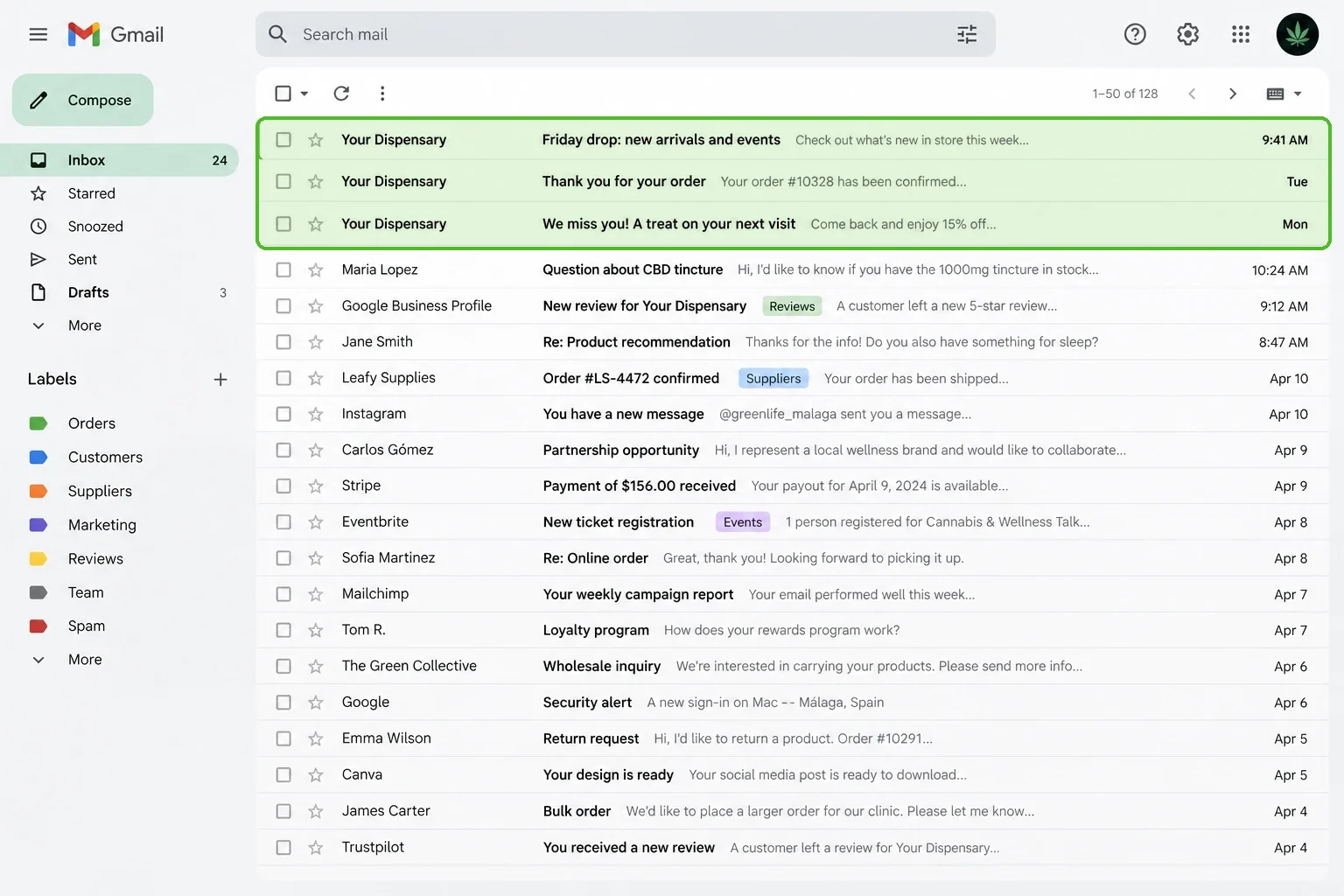
Send each group what it needs:
- Regulars get early access and the first word on every offer.
- New subscribers get a first-visit guide with the hours and, where your state allows it, a small welcome offer.
- People who haven’t bought in months get the comeback offer.
- Anyone who bought on Green Wednesday skips the weekend offers and gets the thank-you.
Test every email on a phone, keep one button in each and lead with the practical details.
Step 7: Get your website and Google ready
A Green Wednesday campaign needs one place to send people. Google’s advice for Black Friday pages is straightforward: publish well before the sale so Googlebot can find it, use a recurring address with no year in it, link to it from your home page and use a relevant, high-quality image. Leave the page up after the sale and update it next year, so the same address keeps what it earned.
Your customers are looking for it. Keyword Surfer estimates about 2,400 US searches a month for “dispensaries open on Thanksgiving” and 1,600 for “green wednesday deals.” When we searched “dispensary Black Friday” on Google with US results on November 5, 2026, six of the nine web results were dispensaries’ own pages. Results change with location, so name your city in the page title and the first line.
Your Green Wednesday page should answer what people ask at the counter and on Google, in plain sentences that AI assistants can read too:
- Do you have deals on Green Wednesday and Black Friday, and which days do they run?
- Are you open on Thanksgiving? List your hours for each day.
- How do pre-orders work, where do I pick up and how long does it take?
- What do I bring? ID, a medical card if needed and an accepted form of payment.
- What’s featured, with offers only where your state allows them on a website.
- A newsletter sign-up, and anything your state requires, such as your license number in California.
Then test the page the way a customer would. Order from a phone at a busy hour: Adobe reports that 57.5% of US online spending on Cyber Monday 2025 came from phones, across all retail. Check that stock syncs with your point of sale, that any discount works as promised and that the page meets Google’s Core Web Vitals targets. Our guide to a dispensary ecommerce website covers menus and checkout in more detail.
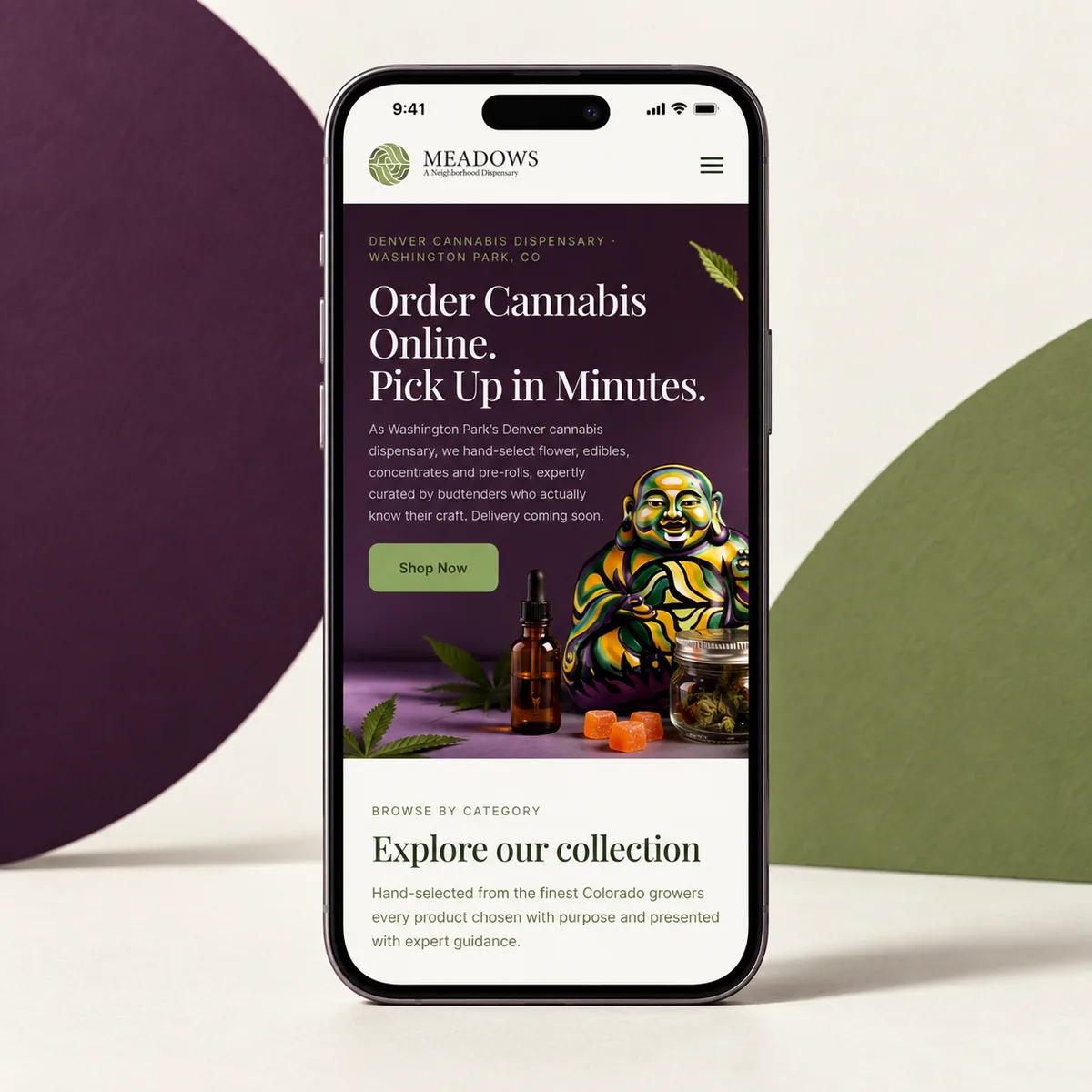
A new website won’t be ready for this Black Friday: most of ours launch in six to eight weeks. A single page on the site you have is realistic, and the week’s numbers will show you what to fix in January. We built the site for Meadows, a neighborhood dispensary in Denver, with age verification and a menu connected to its point of sale, which is the base a campaign like this runs on.
Your Google Business Profile
On Green Wednesday, people often see your Google Business Profile before your website. Add special hours for November 25 to 30. Google recommends confirming your hours for official holidays even when they match your regular ones, so customers know they’re accurate.
Upload fresh photos of the store and answer reviews within a day or two during the rush. Never reward anyone for a review, which Google’s policy doesn’t allow. Our guide to local SEO for dispensaries goes deeper on the rest.
Step 8: Order early and prepare the store for Green Wednesday
Wholesale fills up before the rush. LeafLink, a wholesale marketplace, told Forbes that its orders run about 20% above October averages in the two weeks before Thanksgiving week and then fall, with the biggest jumps in vapes and beverages and a smaller one in edibles. It expects the retailers who order last to face the thinnest selection. Chris Kuilan of Stoops NYC builds his orders around what’s already selling, by SKU, category, price point and brand, so the week doesn’t leave him with slow stock in January.
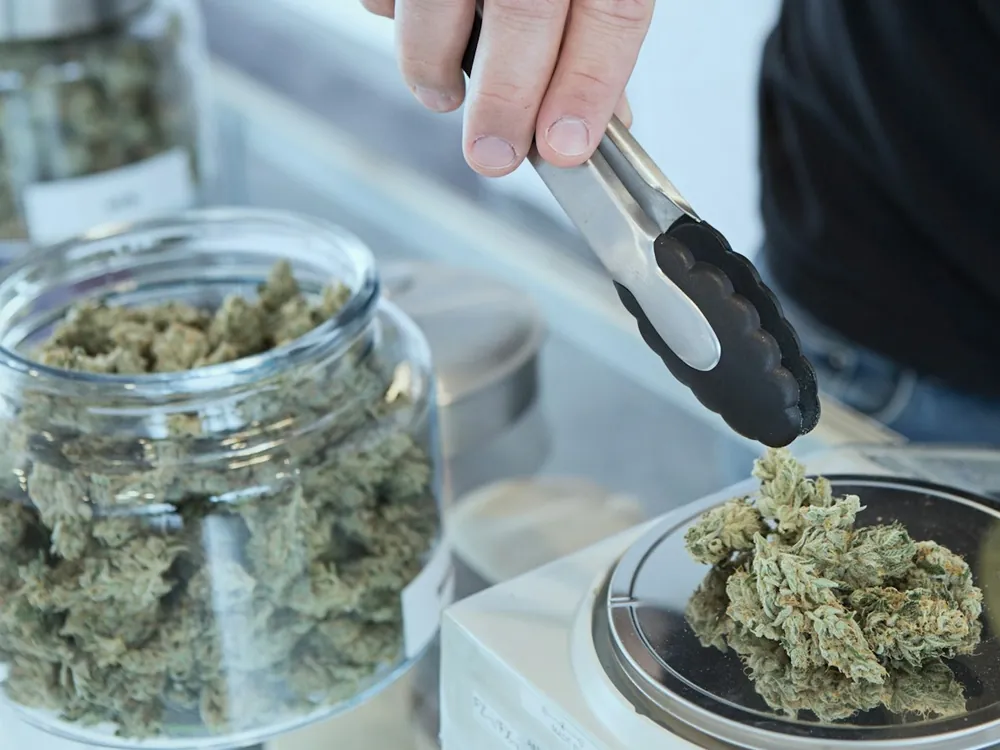
A Green Wednesday campaign brings people in, and the store decides whether they come back. These ideas keep the line moving and the basket full on the two busiest days.
- A pre-order lane. Its own entrance or window, with signs that start on the sidewalk.
- A greeter at the door. Checks ID, answers the first question and sends pre-orders to the right line.
- Staff by the hour. Use last year’s hourly sales from your point of sale to place extra people at the peak, with breaks planned.
- Payment signs. Say what you accept where the line forms, and check that the ATM is full the night before.
- A stock list by category. Compare last year’s week with the shifts in Step 1, then place your final orders early.
- Gift-ready shelves. Group accessories and non-cannabis gifts where people can see them while they wait.
- A one-page budtender brief. Today’s offer, the hours, how pre-orders work and what to avoid saying, starting with health claims and promises of effect.
- Menus for the line. Printed menus or a code for the online menu inside the store, so people decide before they reach the counter.
- End-of-day notes. Five minutes each night: what sold out, when the line peaked and what people asked. It’s the best input you’ll have for 4/20.
Step 9: Green Wednesday on social media
Meta’s Community Standards allow business content from dispensaries, shown to adults only, as long as it doesn’t try to buy, sell, trade or gift cannabis. So the offer lives in your email and on your website, and social media sends people there. None of these ideas needs a price or a discount.
- The date. “Green Wednesday is November 25. Our hours are in our bio. 21+”
- How pre-orders work. A short video of the three steps on a phone, from menu to pickup.
- Getting ready. The team preparing the store for Green Wednesday.
- Meet the crew. One budtender a day in the week before.
- A first-visit guide. Parking, ID, check-in and what to expect when it’s busy.
- Safe storage. Family is visiting, so keep edibles locked and out of reach, and share the Poison Help line, 1-800-222-1222. A study in Pediatrics found that 97.7% of edible exposure cases in children under six happened at home.
- A ride home. Share the federal message Drive High, Get a DUI and remind people to plan their ride.
- Small Business Saturday. The owner’s story, the local growers and the people you hire.
- The list. What subscribers hear first, and a link to sign up.
Add 21+ to every caption, skip anything that could appeal to kids and keep health claims out. Our guide to cannabis social media marketing covers Meta, TikTok and X platform by platform, and our dispensary marketing ideas have more for the rest of the year.
Step 10: Measure the week and keep the customers
Compare each day of your campaign with the four previous same weekdays, the method Headset used in its 2019 comparison, and with the same day last year. Look at:
- Sales after discounts, and your average discount rate.
- Margin by category.
- Pre-orders as a share of Green Wednesday’s sales.
- New email subscribers, unsubscribes and spam rate.
- Orders you can trace to each email and page.
- Customers who bought that week and came back by December 15.
If sales rise and margin holds, keep the offer for next year. If sales stay flat at a deeper discount, you have your answer for next year too.
Plan the weeks after Cyber Monday
The sale ends on November 30, and the return on it comes later. In the Headset report, the share of shoppers who didn’t go back to the same store within six months ran from 58.4% in Michigan to 76.4% in New York and Massachusetts. Put these on the calendar now:
- December 1: thank your customers and welcome new subscribers.
- December 1 to 15: the comeback offer, good for a second visit.
- January: a win-back message based on how long each customer has been away, and a look at any slow stock left over.
Then write three lines for your 4/20 plan: what sold out, what sat on the shelf and what you’d change.
Green Wednesday and Black Friday mistakes to avoid
- Planning only for Friday. Green Wednesday was the bigger day in Headset’s 2025 numbers.
- Copying general retail. Deep cuts on everything give away margin on the days people were coming anyway.
- Choosing the offer before reading your state’s rules. Printing signs twice is the cheap version of that mistake.
- Skipping the math. At a 50% margin, 25% off needs twice the units to earn the same profit.
- Ordering late. The stores that order last choose from what’s left.
- Sending every offer to the whole list. Regulars, new subscribers and people who’ve gone quiet need different messages.
- Putting prices on social media. Meta’s rules can cost you the account.
- Waiting until the week itself to grow your list. The people who sign up on Wednesday missed your best emails.
- A new page address every year. Google recommends a recurring one.
- Promising stock your menu can’t confirm. A sold-out pre-order is a lost customer in the busiest week.
- Skipping the baseline. Without it, you can’t tell a good week from a normal one.
Where to start
Start with the one-page plan and your state’s rules, then write the Green Wednesday email. Writing it forces the decisions on hours, pre-orders and offer, and everything else in your dispensary Black Friday campaign follows from them. For the rest of the year, our 2027 cannabis marketing calendar lists the dates that sell, each with a campaign idea, an email subject line and a caption.
Our November offer for dispensaries
Two ways to work with us this month.
Frequently asked questions
-
It is the Wednesday before Thanksgiving, when cannabis shoppers stock up for the long weekend. In Headset's data it is the second biggest cannabis sales day of the year, after 4/20. In 2026 it falls on November 25.
-
Green Wednesday 2026 is Wednesday, November 25, the day before Thanksgiving. In 2027 it falls on November 24. Black Friday 2026 is November 27, Small Business Saturday is November 28 and Cyber Monday is November 30.
-
Green is a common word for cannabis, and the name follows the pattern of Black Friday and Cyber Monday.
-
There is no firm date. Joyce Cenali of the Cannabis Media Council told CNN that brands adopted the name after legalization in the mid-2010s, and Weedmaps says it is thought to have started in 2017.
-
No. It is a sales day the cannabis industry built around the night before Thanksgiving, when friends and families get together and people stock up for the long weekend.
-
BDSA put the average discount for Green Wednesday week 2024 at 28.65%. Stores commonly use percentage offers, bundles, early access, limited releases and bonus loyalty points, where their state allows them.
-
It is a plan for the six days from Green Wednesday to Cyber Monday: the offer for each day, the email sequence, a page on your website, your Google Business Profile hours, social posts, in-store logistics and how you will measure the results.
-
People stock up before a long weekend of travel and family. Headset's look at 2019 sales read Green Wednesday buyers as people stocking up and less sensitive to price, and in a Sweed survey from October 2025, 45% of US cannabis consumers said they planned to buy or stock up around that day.
-
Yes, in Headset's latest table. Green Wednesday 2025 brought in $114.0 million and Black Friday 2025 brought in $108.1 million, the second and third biggest days of the 12 months to September 2026, after 4/20. It changes by region: Lit Alerts' CEO told Forbes the two days run close in Ohio, Illinois and Missouri, and that Black Friday drops off in New York, New Jersey and Massachusetts.
-
It is a large day with a small lift. Headset put Black Friday 2025 at $108.1 million, 1.6 times an average day, but its earlier reports compared it with an average Friday and found a 1% gain in 2022 and a 3 to 5% decline in its 2024 analysis.
-
Many do. In Headset's 2022 data the average discount on Black Friday was 23.7%, the deepest of the holiday stretch. What a store can advertise depends on its state, so some show deals only by email or inside the store.
-
It varies by store. Headset measured sales down 65% on Thanksgiving 2022, so short hours or a closed door both make sense. Whatever you decide, add it to your Google Business Profile ahead of time.
-
Only after checking your margin and your state's rules. Headset's reports show the deepest discounts of the week on Black Friday with little lift over a normal Friday, so many of the ideas in this guide add value through early access, pre-orders, kits and comeback offers.
-
Divide the discount by your gross margin minus the discount. At a 50% margin, 25% off needs 100% more units to earn the same gross profit, and 10% off needs 25% more. Run it with your own margins, category by category.
-
In Headset's 2022 data the average discount was 19.8% on Green Wednesday, 22.2% on Thanksgiving and 23.7% on Black Friday. Its 2024 analysis says the average for Thanksgiving week jumped from 17.9% to 25%. Its latest figures put the average discount across the year at 27.1% of shelf value.
-
In Headset's retention report for nine states, shoppers who got any first-visit discount returned more often, 36.8% against 26.9%, and the size barely changed that. Shoppers who got 1 to 10% off were worth $193 over 180 days against $109 for 50% or more, with exceptions such as Ohio and Illinois.
-
Headset's holiday reports show gains in topicals, beverages and edibles, and declines in flower and concentrates, during the holiday stretch in 2022. In Massachusetts in 2025, vapes and pre-rolls gained share from flower. Check those shifts against your own point-of-sale data before you place your last orders.
-
Flower leads at 39.1% of sales, followed by vapes at 25.5%, pre-rolls at 16.1% and edibles at 11.8%, in Headset's data for the 12 months to September 2026.
-
In October or early November if you can. LeafLink told Forbes its wholesale orders run about 20% above October averages in the two weeks before Thanksgiving week, with the biggest jumps in vapes and beverages, and that it expects retailers who order last to face the thinnest selection.
-
It depends on the state. New York's guidance bans buy-one-get-one-free offers, Oregon bars discounting an item sold together with another item, and Massachusetts says bundles can't be marketed as free, discounted or promotional. Ask your regulator or an attorney.
-
In many states, no. California bars giving away cannabis, cannabis products or accessories as a business promotion, Colorado says a retail store may not give away retail marijuana for any reason, and Oregon and Washington also restrict free items.
-
Rules differ. Washington allows coupons that don't take a price below the retailer's acquisition cost, New York allows promotions above market value, and Massachusetts bars adult-use licensees from advertising coupons. Check your state's current rules.
-
It depends on the state. New York allows promotional prices on your website, while a Massachusetts bulletin of September 25, 2026 says showing a reduced price on an online menu counts as advertising and can lead to a citation for adult-use licensees.
-
No. Meta's Community Standards allow business content from dispensaries, shown to adults only, as long as it doesn't try to buy, sell, trade or gift cannabis. Share your hours, your team and how pre-orders work, and send people to your website and newsletter for the offer.
-
Google's policies limit cannabis-related advertising, and its CBD route covers only topical, non-pharmaceutical CBD in California, Colorado and Puerto Rico with certification. Most dispensaries rely on organic search and their Google Business Profile for this week.
-
Usually, to adults who opted in, within your state's rules. The CAN-SPAM Act requires honest subject lines, a postal address and a clear opt-out. New York lists email as an allowed channel for promotional prices, and California asks for age affirmation before direct messages.
-
Check first. Twilio says cannabis and CBD businesses can't use its text messaging in the US or Canada, and other platforms have their own limits. Some cannabis marketing platforms offer texting, so ask yours in writing how its messages reach the carriers, and get written consent from everyone you text.
-
There is no official number. This guide plans nine from November 16 to December 1, because each one has a practical job: dates, pre-orders, hours, thanks and a comeback offer. With a small list, send the Tuesday, Thursday and Sunday emails first.
-
Ask at the counter, put a QR code on receipts and bags, add a bar across your website and a check box on the pre-order form, send your bio link to the form, and give the team a small goal. Collect addresses only from adults 21 and over, with consent.
-
Around Labor Day, about 12 weeks out, is the usual advice. Three weeks is still enough for a good campaign if you keep it simple: one page of plan, one offer per day, one campaign page on your website and the email sequence.
-
Schedule by the hour using last year's point-of-sale data, plan breaks and give every budtender a one-page brief with the day's offer, the hours, how pre-orders work and what to avoid saying.
-
It helps, because your emails and posts need one place to send people, and dispensaries' own pages show up when people search for Black Friday deals. Google recommends publishing it well before the sale, using a recurring address with no year in it and linking to it from your home page.
-
Yes. Add special hours for November 25 to 30. Google recommends confirming your hours for official holidays even when they match your regular ones, so customers know they are accurate.
-
An online offer for your email list, for pickup or delivery, where your state allows it. Cyber Monday isn't among the five biggest days in Headset's 2026 table, so keep it simple and low in cost.
-
Tell your local story: the owner, the team, the growers you buy from and the neighborhood you serve. It works in email, in the store and on social media, because it needs no price.
-
Compare each day with the four previous same weekdays and with the same day last year. Track sales after discounts, average discount rate, margin by category, pre-orders, new subscribers and customers who come back by December 15.
-
Thank customers and welcome new subscribers, run the comeback offer from December 1 to 15, and in January write to people based on how long they've been away. In Headset's retention report, 67.1% of shoppers didn't return to the same store within six months.
-
Probably not if you start now: most of our websites launch in six to eight weeks. A single campaign page on your current site is realistic, and the week's numbers will show you what to fix for next year.